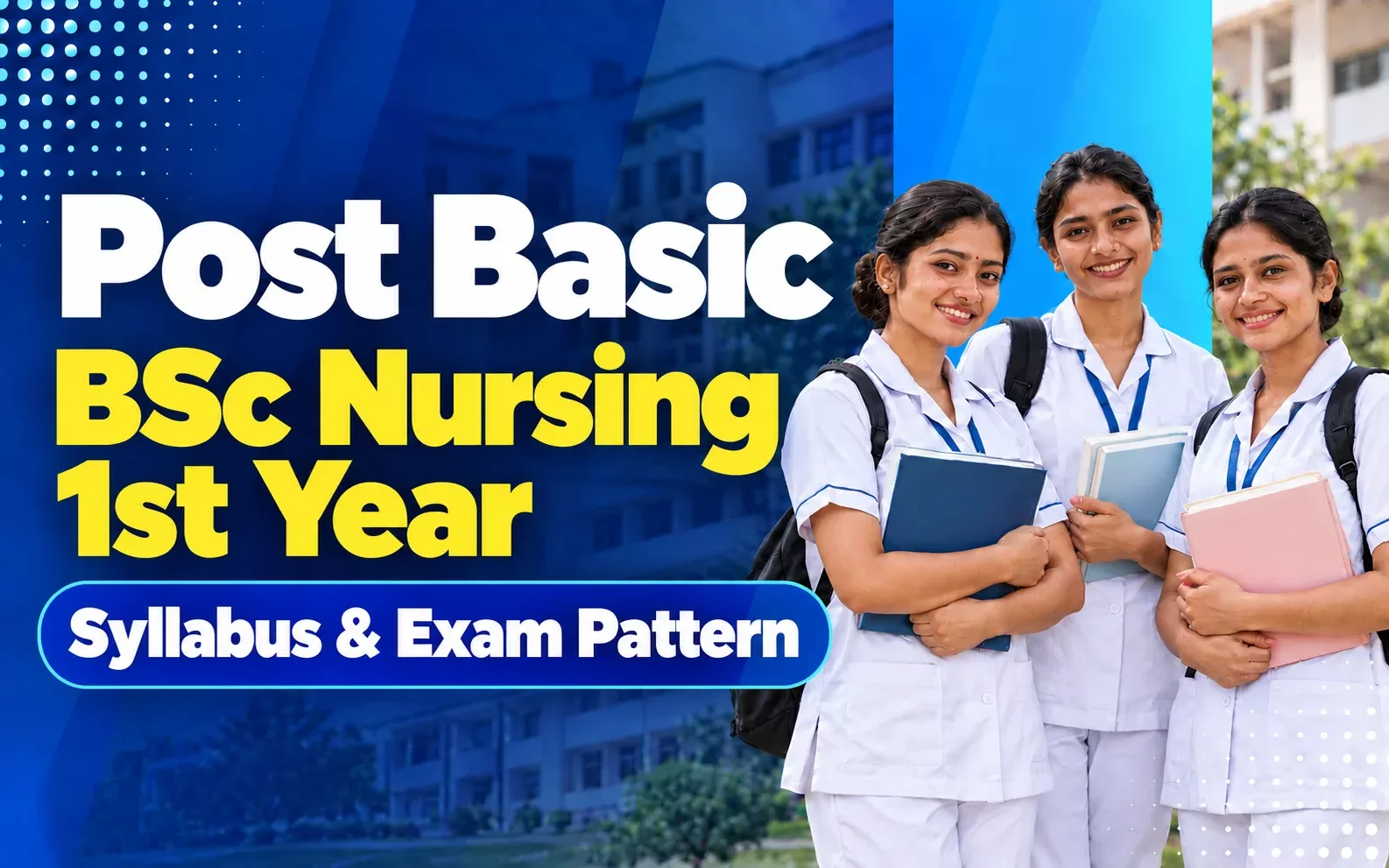
POST BASIC B.Sc. NURSING • AFTER GNM • 1st YEAR
Post Basic BSc Nursing 1st Year Syllabus & Exam Pattern 2026
Completed GNM and joined the 2-year Post Basic B.Sc. Nursing (P.B.B.Sc.) course? Here are the 1st year subjects, teaching hours, unit-wise syllabus, marks distribution and passing rules as per the Indian Nursing Council (INC) course of instruction followed by universities.
Quick answer
Post Basic BSc Nursing is a 2-year degree for GNM-qualified registered nurses (RN RM). The 1st year has 9 theory subjects — Nursing Foundation, Nutrition & Dietetics, Biochemistry & Biophysics, Psychology, Microbiology, Maternal Nursing, Child Health Nursing, Medical Surgical Nursing and English (qualifying) — with 525 theory + 810 practical hours (1335 hours). The annual university exam has theory papers of 100 marks (25 internal + 75 external; 3 hours), except Nursing Foundation and Nutrition (50 marks each; 2 hours), plus 3 practicals of 100 marks each. You need 50% separately in theory and practical and 80% attendance.
2 Years
Course duration (after GNM)
9
Theory subjects in 1st year
3
Practical exams
1335
Total hours in 1st year
In this guide
About the course Eligibility Subjects & hours Exam pattern Passing rules Unit-wise syllabus 2nd year subjects Preparation tips
What Is Post Basic BSc Nursing?
Post Basic B.Sc. Nursing (P.B.B.Sc. Nursing) is a 2-year bachelor's degree for nurses who have already completed the GNM (General Nursing and Midwifery) diploma and are registered with a State Nursing Council. It upgrades a diploma nurse to a graduate nurse, which helps in promotions, higher studies such as M.Sc. Nursing, and teaching or supervisory roles.
Unlike the 4-year Basic B.Sc. Nursing (semester system), Post Basic B.Sc. Nursing follows a yearly (annual) examination system. Universities follow the course of instruction and scheme of examination prescribed by the Indian Nursing Council.
Post Basic BSc Nursing Eligibility (INC)
- Passed 10+2 (Higher Secondary / Senior Secondary / Intermediate) or an equivalent exam recognised by the university. Those who did 10+1 in or before 1986 are also eligible.
- Obtained a certificate in General Nursing and Midwifery (GNM) and registered as R.N.R.M. with the State Nurses Registration Council.
- A male nurse trained before the integrated course must show INC-approved training of similar duration (e.g. OT Techniques, Ophthalmic, Psychiatric, Community Health, Cancer, Orthopaedic Nursing) in lieu of midwifery.
- Candidates must be medically fit. Admission is once a year (usually through the university/state entrance test).
Post Basic BSc Nursing 1st Year Subjects and Teaching Hours
| S.No. | Subject | Theory hours | Practical hours | Total |
|---|---|---|---|---|
| 1 | Nursing Foundation | 45 | — | 45 |
| 2 | Nutrition & Dietetics | 30 | 15 | 45 |
| 3 | Biochemistry & Biophysics | 60 | — | 60 |
| 4 | Psychology | 60 | 15 | 75 |
| 5 | Maternal Nursing | 60 | 240 | 300 |
| 6 | Child Health Nursing | 60 | 240 | 300 |
| 7 | Microbiology | 60 | 30 | 90 |
| 8 | Medical Surgical Nursing | 90 | 270 | 360 |
| 9 | English (Qualifying) | 60 | — | 60 |
| Total – 1st Year | 525 | 810 | 1335 | |
Practical hours for Maternal, Child Health and Medical Surgical Nursing are clinical postings. Biochemistry & Biophysics is one subject with two sections (30 hours each).
Post Basic BSc Nursing 1st Year Exam Pattern (Scheme of Examination)
The 1st year exam is an annual university examination. Every paper has internal assessment (from college tests, assignments and clinical work) and an external university exam.
Theory papers
| Subject | Exam hours | Internal | External | Total |
|---|---|---|---|---|
| Nursing Foundation | 2 | 15 | 35 | 50 |
| Nutrition & Dietetics | 2 | 15 | 35 | 50 |
| Biochemistry & Biophysics | 3 | 25 | 75 | 100 |
| Psychology | 3 | 25 | 75 | 100 |
| Microbiology | 3 | 25 | 75 | 100 |
| Maternal Nursing | 3 | 25 | 75 | 100 |
| Child Health Nursing | 3 | 25 | 75 | 100 |
| Medical Surgical Nursing | 3 | 25 | 75 | 100 |
| English (Qualifying) | 3 | 25 | 75 | 100 |
Practical & viva exams
Medical Surgical Nursing
Internal 50 + External 50 = 100
Maternal Nursing
Internal 50 + External 50 = 100
Child Health Nursing
Internal 50 + External 50 = 100
Key points of the 1st year exam pattern
- Nursing Foundation and Nutrition & Dietetics are 50-mark, 2-hour papers; all other theory papers are 100 marks, 3 hours.
- Biochemistry & Biophysics is one paper in two sections — Biochemistry 38 marks and Biophysics 37 marks (external 75).
- English is a qualifying paper — you must pass it; the minimum pass mark is fixed by your university.
- Practicals are held only for the three clinical subjects: Medical Surgical, Maternal and Child Health Nursing.
Passing Marks and Attendance Rules
| Paper | Total marks | Minimum to pass (50%) |
|---|---|---|
| Nursing Foundation / Nutrition & Dietetics | 50 | 25 |
| Other theory papers (100 marks) | 100 | 50 |
| Each practical | 100 | 50 |
- 50% separately in theory and practical of each subject.
- 80% attendance in theory and practical/clinical of each subject is required to appear in the exam, and 100% clinical attendance is required before the degree is awarded.
- If you fail in theory or practical, you must re-appear for both theory and practical of that subject.
- Practical exams are held in the clinical area by one internal and one external examiner, with not more than 20 candidates per day.
- The course should be completed within the maximum period allowed by your university (commonly 8 years from admission in INC-based regulations).
Post Basic BSc Nursing 1st Year Syllabus (Unit-Wise Topics)
1. Nursing Foundation (45 h)
- Development of nursing as a profession, code of ethics, professional organisations
- Ethical & legal issues, health and illness, stress and adaptation
- Theories of nursing practice (meta-paradigm)
- Nursing process and assessment tools
- Quality assurance – nursing standards, nursing audit
- Primary health care concept, progressive patient care, team nursing
2. Nutrition & Dietetics (30 + 15 h)
- Introduction to nutrition and dietetics, balanced diet
- Nutritional needs of different age groups
- Introduction to diet therapy, routine hospital diets
- Planning of therapeutic diets in different settings
- Meal preparation using cookery rules
3. Biochemistry & Biophysics (60 h)
- Biochemistry: importance in nursing, water & electrolytes, enzymes, carbohydrates, proteins & amino acids, fats
- Biophysics: units & measurement, motion, force-work-energy, heat, light, pressure, sound, electricity & electromagnetism, atomic energy, principles of electronics
4. Psychology (60 + 15 h)
- Introduction, sensation, attention and perception
- Motivation, emotions, personality
- Psychological aspects of nursing, individual differences
- Learning, memory and forgetting, attitudes
- Mental hygiene and mental health
5. Microbiology (60 + 30 h)
- Structure, classification and identification of microbes
- Growth and nutrition of microbes; sterilisation & disinfection
- Disease-producing bacteria, pathogenic fungi, viruses
- Immunity and hypersensitivity
- Parasites and vectors; micro-organisms transmitted through food
6. Maternal Nursing (60 + 240 h)
- Introduction, historical review, planned parenthood
- Anatomy & physiology of female reproductive system
- Normal pregnancy, labour and puerperium
- The newborn baby and care at birth
- Abnormal pregnancy, labour and puerperium
- Drugs in obstetrics; national welfare programmes for women
7. Child Health Nursing (60 + 240 h)
- Modern concept of child care
- The healthy child – growth and development
- Nursing care of a neonate
- Nursing management of common childhood diseases
- Management of behavioural disorders in children
8. Medical Surgical Nursing (90 + 270 h)
- Introduction to medical surgical nursing
- Nursing management of neurological, cardiovascular, respiratory, genito-urinary, digestive, endocrine and musculoskeletal problems
- Disorders of the female reproductive tract, oncological disorders, burns
- Communicable diseases; eye, ear, nose and throat; blood disorders
- Nursing in emergencies
9. English – Qualifying (60 h)
- Remedial study of grammar and vocabulary
- Understanding selected passages and expressing them in own words
- Forms of composition such as note taking and summarising
- Verbal communication – oral reports and summarising discussions
What Comes in Post Basic BSc Nursing 2nd Year?
For planning ahead, the 2nd year subjects are: Sociology, Community Health Nursing, Mental Health Nursing, Introduction to Nursing Education, Introduction to Nursing Administration and Introduction to Nursing Research & Statistics (with a research project, assessed as a college exam), with practicals in Community Health Nursing and Mental Health Nursing. Read the full Post Basic BSc Nursing 2nd Year Syllabus & Exam Pattern guide.
How to Prepare for Post Basic BSc Nursing 1st Year Exams
- Use your GNM base: Maternal, Child Health and Medical Surgical Nursing overlap with GNM — revise quickly, then focus on degree-level depth and nursing process.
- Give extra time to new subjects: Biochemistry & Biophysics, Psychology and Microbiology are new for most GNM nurses — make short notes and diagrams.
- Don't neglect 50-mark papers: Nursing Foundation and Nutrition need 25 marks each to pass — plan diets and nursing-process answers.
- Protect internal marks: Keep 80%+ attendance, submit assignments, care plans and case studies on time.
- Practise for practicals: Procedures, case presentations and viva for the three clinical subjects carry 100 marks each.
Online classes, free PDF notes & PYQ support
Prepare for your Post Basic B.Sc. Nursing and nursing competitive exams with the Testpaperlive Classes app — classes, free PDF notes and previous-year papers in one place. Need guidance? Message us on WhatsApp.
Related Nursing Syllabus Guides
- Basic BSc Nursing 1st Year Syllabus (Semester 1 & 2)
- Basic BSc Nursing 2nd Year Syllabus (Semester 3 & 4)
- B.Sc Nursing Syllabus 2026 (INC Revised) – Semester-wise
Sources: INC – Eligibility Criteria (Post Basic B.Sc. Nursing); Post Basic B.Sc. Nursing syllabus and scheme of examination as per INC, published by M.J.P. Rohilkhand University.
Note: Universities follow the INC scheme but may add minor changes (paper codes, extra value-added courses, exam dates). Always confirm with your own university's syllabus and exam notice.