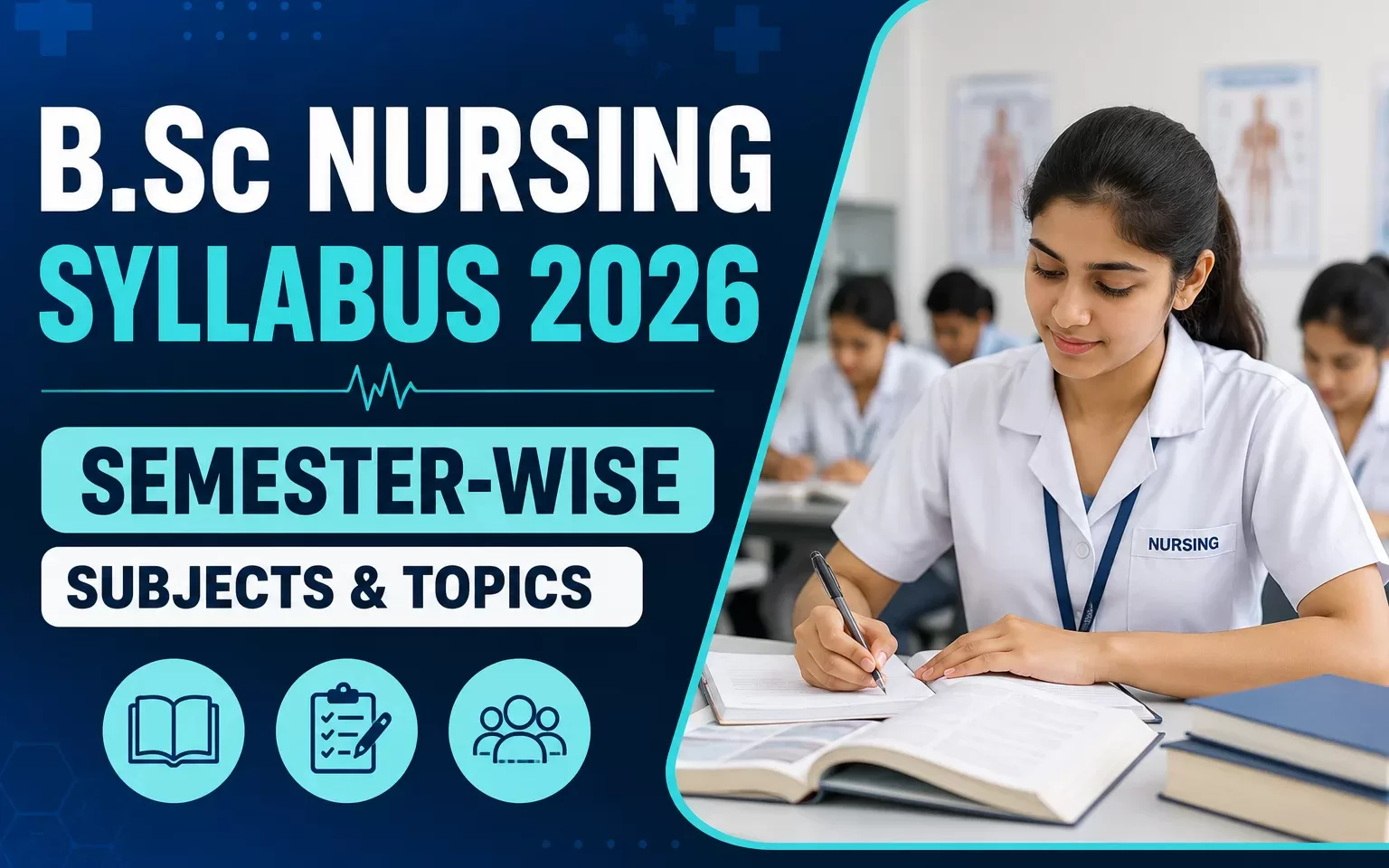
B.Sc Nursing Syllabus 2026 (INC Revised): Year & Semester-Wise Subjects with Topics
The Indian Nursing Council (INC) has restructured the B.Sc Nursing programme into a full semester system based on a competency-based education model. The course now runs across 8 semesters over 4 years, combining classroom theory, skill-lab practice, clinical postings, and a final-year internship. This guide gives you the complete B.Sc Nursing Syllabus 2026 — every year broken into semester tables, every subject with its key topics, the latest INC exam rule, the entrance exam syllabus, recommended books, and how this syllabus connects directly to government nursing recruitment exams.
⚡ Quick Answer (At a Glance)
- Course: Bachelor of Science in Nursing — 4 years, 8 semesters
- Regulator: Indian Nursing Council (INC), revised semester curriculum
- Pattern: Competency-based — theory + skill labs + clinical postings + final-year internship
- New Rule (Aug 2025): Students can sit the 5th-semester exam even with pending earlier papers
- Useful for jobs: AIIMS NORCET, RRB Staff Nurse, AIIMS CRE, ESIC, State Nursing Officer
📢 INC B.Sc Nursing Exam Rule Update (2025–26)
In August 2025, the INC amended its examination regulations. The earlier restrictive clause (sub-para 16(i)) was removed, which means a student can now appear for the 5th-semester examination even if some earlier-semester papers are still pending. This prevents a back paper from stalling a student's entire academic progress.
However, two conditions remain unchanged: all previous papers must be cleared before the 7th-semester (final) examination, and the maximum permissible duration to complete the course is 8 years. Always confirm the exact rule with your own university or on the official INC website, as states/universities may apply it slightly differently.
B.Sc Nursing 2026 – Course Overview
| Particular | Detail |
|---|---|
| Full Form | Bachelor of Science in Nursing |
| Level | Undergraduate Degree |
| Duration | 4 Years (8 Semesters) |
| Eligibility | 10+2 with Physics, Chemistry, Biology & English (approx. 45–50%) |
| Admission | NEET / State & University Entrance Exams |
| Regulating Body | Indian Nursing Council (INC) |
| Assessment | Theory + Practical/OSCE + Continuous Clinical Evaluation (pass separately) |
B.Sc Nursing 1st Year Syllabus (Semester 1 & 2)
The first year builds the academic, ethical, and clinical foundation of nursing. The focus is on understanding the human body, basic sciences, professional behaviour, and core nursing skills, with early clinical exposure.
| Semester | Subjects |
|---|---|
| Semester I | Applied Anatomy & Physiology, Applied Sociology & Psychology, Nursing Foundations I, Communicative English, Introduction to Computers, General Science |
| Semester II | Applied Biochemistry, Applied Nutrition & Dietetics, Nursing Foundations II, Introduction to Community Health Nursing |
Key Topics – 1st Year Subjects
| Subject | Important Topics |
|---|---|
| Nursing Foundations I & II | Evolution & scope of nursing, nurse's roles, ethics & legal issues, nursing process (assessment–diagnosis–planning–implementation–evaluation), infection control, vital signs, hygiene & comfort, documentation, basic procedures |
| Anatomy & Physiology | Cells, tissues & body organisation; musculoskeletal, cardiovascular, respiratory, digestive, urinary, nervous & endocrine systems with clinical correlation |
| Biochemistry | Carbohydrates, proteins, lipids, enzymes, vitamins; metabolism; fluid & electrolyte balance; common diagnostic biochemical tests |
| Nutrition & Dietetics | Principles of nutrition, balanced diet, nutrients, therapeutic & hospital diets, nutrition during illness, nutritional assessment |
| Psychology & Sociology | Psychological processes, learning & memory, motivation & emotions, stress & coping, personality; society, family, community & health |
| English & Computers | Therapeutic communication, medical terminology, report writing; computer basics & healthcare informatics |
B.Sc Nursing 2nd Year Syllabus (Semester 3 & 4)
The second year shifts toward disease processes and adult patient care. Pharmacology, pathology and microbiology support the first major clinical subject — Adult Health (Medical-Surgical) Nursing.
| Semester | Subjects |
|---|---|
| Semester III | Pharmacology I, Pathology I, Applied Microbiology & Infection Control, Adult Health Nursing I (Medical-Surgical), Professionalism, Ethics & Bioethics |
| Semester IV | Pharmacology II, Pathology II & Genetics, Adult Health Nursing II (with Geriatrics), Educational Technology / Nursing Education |
Key Topics – 2nd Year Subjects
| Subject | Important Topics |
|---|---|
| Pharmacology I & II | Drug classification, routes & dosage, pharmacokinetics & pharmacodynamics, drugs by system (CVS, respiratory, GI, CNS, antibiotics), drug calculations, adverse reactions & nurse's responsibility |
| Pathology & Genetics | Cell injury & inflammation, healing, neoplasm basics, common disease pathology, blood disorders, basics of genetics & inheritance |
| Microbiology & Infection Control | Bacteria, viruses, fungi & parasites; immunity; sterilisation & disinfection; hospital-acquired infections; standard precautions; biomedical waste management |
| Adult Health Nursing I & II | Nursing care of disorders of respiratory, cardiovascular, GI, renal, endocrine, musculoskeletal & integumentary systems; perioperative care; fluid–electrolyte management; geriatric nursing |
| Nursing Education / Ed. Technology | Teaching–learning principles, methods & media, planning health education, patient & community teaching |
B.Sc Nursing 3rd Year Syllabus (Semester 5 & 6)
The third year is the most clinically intensive phase, covering specialised disciplines — paediatrics, psychiatry, advanced medical-surgical care, midwifery, plus nursing research and management.
| Semester | Subjects |
|---|---|
| Semester V | Child Health Nursing I, Mental Health Nursing I, Nursing Research & Statistics, Nursing Management & Leadership, Nursing Informatics & Technology, Forensic Nursing & Indian Laws |
| Semester VI | Child Health Nursing II, Mental Health Nursing II, Community Health Nursing I, Midwifery & Obstetrical Nursing I |
Key Topics – 3rd Year Subjects
| Subject | Important Topics |
|---|---|
| Child Health Nursing | Growth & development, care of the newborn, neonatal nursing, immunisation, paediatric nutrition, common medical & surgical conditions of children, national child-health programmes |
| Mental Health Nursing | Concepts of mental health & illness, psychiatric assessment & mental status exam, schizophrenia, mood & anxiety disorders, substance abuse, psychiatric emergencies, therapeutic communication, mental health legislation |
| Medical-Surgical Nursing II | Advanced care in cardiovascular, respiratory, neurological, renal & endocrine disorders; oncology & palliative care; emergency, disaster & ICU nursing |
| Midwifery & Obstetrical Nursing | Female reproductive anatomy, antenatal–intranatal–postnatal care, normal & high-risk pregnancy, labour & puerperium, newborn care, family planning |
| Nursing Research & Management | Research process, methodology & basic statistics; principles of management, leadership, ward & personnel management, records & reports |
B.Sc Nursing 4th Year Syllabus (Semester 7 & 8)
The final year focuses on leadership, community-level care, research application and a mandatory rotatory internship that transitions a student into an independent professional nurse.
| Semester | Subjects / Components |
|---|---|
| Semester VII | Community Health Nursing II, Midwifery & Obstetrical Nursing II, Internship / Residency (clinical postings) |
| Semester VIII | Internship / Residency (continued) — specialised clinical practice, professional practice preparation, final evaluations |
Key Topics – 4th Year Subjects
| Subject | Important Topics |
|---|---|
| Community Health Nursing II | Primary health care, national health programmes & policies, epidemiology & communicable disease control, family health, school & occupational health, health administration |
| Midwifery / OBG II | Complicated pregnancy & labour, obstetric emergencies, gynaecological disorders, maternal & child welfare services |
| Internship / Residency | Supervised rotation through medicine, surgery, OBG, paediatrics, community & specialty units; independent practice under guidance; competency logbook completion |
B.Sc Nursing Entrance Exam Syllabus 2026 (Physics, Chemistry, Biology)
Entrance exams such as NEET draw from the Class 11 & 12 (NCERT) science syllabus:
| Subject | Key Topics |
|---|---|
| Physics | Units & measurement, kinematics, laws of motion, work–energy–power, gravitation, thermodynamics, current electricity, magnetism, atoms & nuclei |
| Chemistry | Atomic structure, chemical bonding, states of matter, thermodynamics, equilibrium, electrochemistry, chemical kinetics, p-block elements, biomolecules |
| Biology | Cell structure & function, plant & human physiology, reproduction, genetics & evolution, biology in human welfare, biotechnology, ecology |
Tip: Thorough revision of NCERT (Class 11 & 12) is the single most effective entrance strategy.
How This Syllabus Helps in Government Nursing Exams
The B.Sc Nursing syllabus is also the core base for Nursing Officer / Staff Nurse recruitment exams. The same subjects are tested repeatedly in:
- AIIMS NORCET – Nursing Officer Recruitment Common Eligibility Test
- RRB Staff Nurse and AIIMS CRE (Common Recruitment Examination)
- ESIC, DSSSB and various State Nursing Officer recruitments
The highest-yield areas are Medical-Surgical Nursing, Community Health Nursing, Nursing Foundation, Child Health Nursing, Mental Health Nursing, Pharmacology and Midwifery / OBG. Studying these well lets a student cover college exams and competitive exams together.
Examination Pattern & Assessment (INC)
- University theory examinations + internal assessments
- Practical / OSCE / viva-voce examinations
- Continuous clinical evaluation through the year
- Theory and practical must be passed separately
- Competency logbook maintained and evaluated internally
Recommended Books
| Subject | Recommended Book |
|---|---|
| Nursing Foundations | Fundamentals of Nursing – Potter & Perry / B.T. Basavanthappa |
| Anatomy & Physiology | Ross & Wilson – Anatomy and Physiology |
| Medical-Surgical Nursing | Brunner & Suddarth's Textbook of Medical-Surgical Nursing |
| Child Health Nursing | Pediatric Nursing – Parul Datta |
| Mental Health Nursing | Mental Health (Psychiatric) Nursing – K. Lalitha |
| Midwifery / OBG | Midwifery & Obstetrical Nursing – D.C. Dutta (Nursing Edition) |