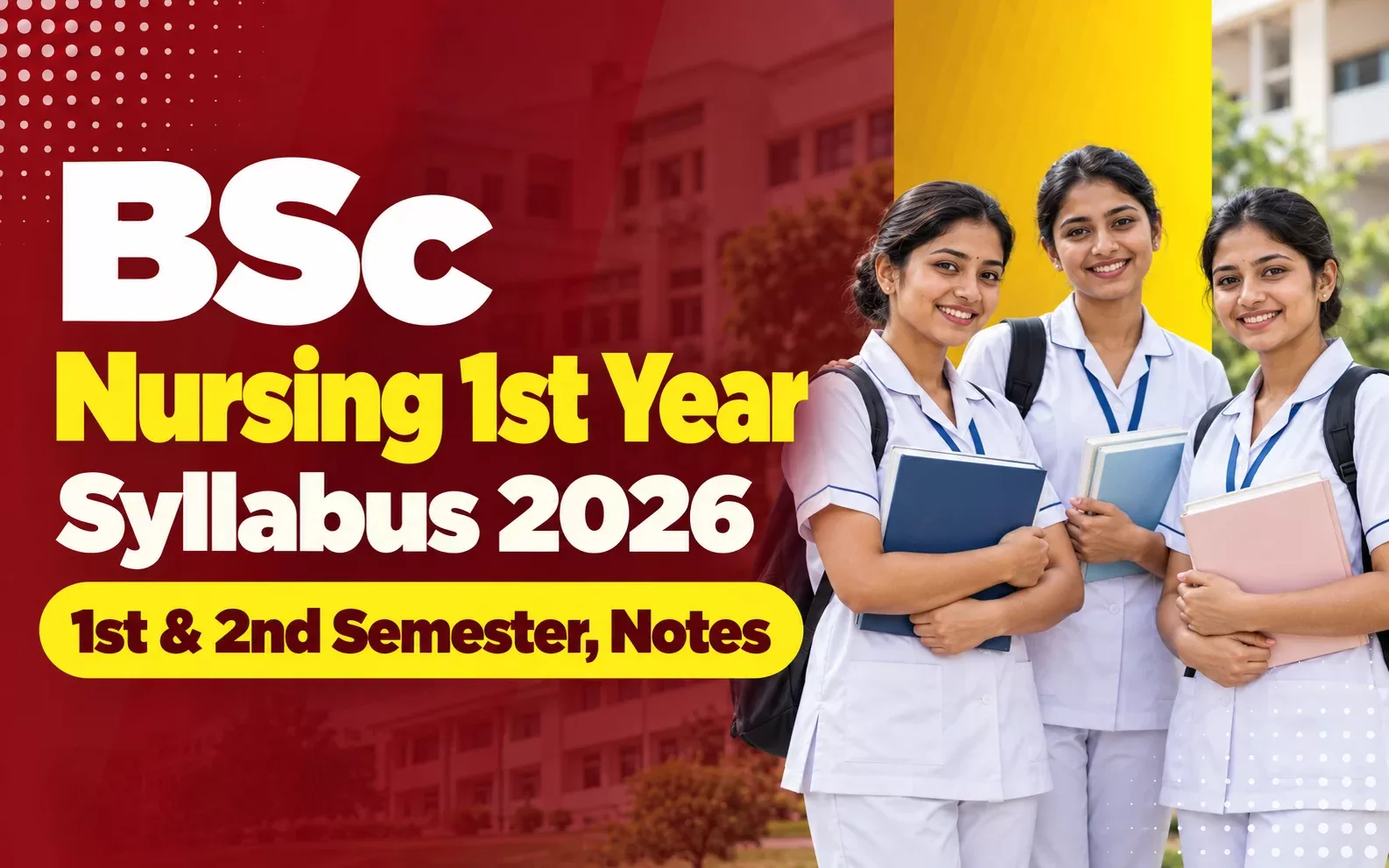
BSc NURSING • FIRST YEAR • SEMESTER I & II
Start your nursing journey with a clear study plan
BSc Nursing 1st year covers the first two semesters. Build your understanding of the human body, behaviour and basic nursing care, then connect classroom learning with supervised practical training.
2
Semesters in year 1
6
Semester 1 courses
4
Semester 2 courses
Skills
Lab + clinical learning
Looking for the BSc Nursing 1st year syllabus 2026, first-semester subjects or second-semester study material? This guide brings the semester-wise subject list, teaching hours, exam scheme and preparation resources together in one place.
Reviewed: 28 September 2026. This guide uses the INC revised semester curriculum notified in 2021 and the 2022 corrigendum. “2026” identifies this updated guide; it does not mean INC issued a completely new first-year syllabus in 2026. Match your admission batch with your university’s official scheme.
Online classes, free PDF notes & PYQ support
Prepare with the Testpaperlive Classes app. Explore BSc Nursing classes, check the free study material for PDF notes, and look for available previous-year papers for your semester and university.
Quick navigation
Semester 1 · Semester 2 · Practical training · Exam scheme · Syllabus PDF · Classes, notes & PYQs · Study plan
BSc Nursing 1st Year: What Does It Include?
The revised BSc Nursing degree runs across four years and eight semesters. First year means Semester I plus Semester II, rather than one combined annual subject list. The course counts above refer to teaching subjects; some subjects are combined into a single examination paper. Source: INC curriculum overview.
Use the tables below as your subject checklist. The short topic summaries explain the scope; download the full curriculum for the complete unit-wise learning outcomes. Your college timetable also includes self-study, co-curricular work and the relevant module requirements.
BSc Nursing 1st Semester Syllabus and Subjects
| Course | Theory hours | Lab / clinical hours |
|---|---|---|
| Communicative English | 40 | — |
| Applied Anatomy | 60 | — |
| Applied Physiology | 60 | — |
| Applied Sociology | 60 | — |
| Applied Psychology | 60 | — |
| Nursing Foundation I, including First Aid | 120 | 80 skill lab + 160 clinical |
Teaching-hour reference: VINS published curriculum. Hours are learning allocations, not marks or exam duration.
Subject-wise topic summary
- Communicative English: listening, speaking, reading, writing and professional communication.
- Applied Anatomy: body organisation, tissues, organs and the major body systems.
- Applied Physiology: normal body functions, blood, circulation, respiration, digestion, excretion and regulation.
- Applied Sociology: society, culture, family, social organisation, social problems and health.
- Applied Psychology: behaviour, learning, memory, personality, emotions, motivation and stress.
- Nursing Foundation I: nursing concepts, communication, documentation, vital signs, safety, comfort, mobility and First Aid.
Study approach: Pair a structure with its function. After revising the heart in Anatomy, explain circulation in your own words and practise a labelled diagram. For Sociology and Psychology, write a definition, a short explanation and a nursing-related example instead of memorising disconnected lines.
BSc Nursing 2nd Semester Syllabus and Subjects
| Course | Theory hours | Lab / clinical hours |
|---|---|---|
| Applied Biochemistry | 40 | Includes relevant practical exposure within the course |
| Applied Nutrition & Dietetics | 60 | Includes nutrition practical work within the allocation |
| Nursing Foundation II, including Health Assessment | 120 | 120 skill lab + 320 clinical |
| Health/Nursing Informatics & Technology | 40 | 40 lab |
Semester allocation cross-check: Sharda University BSc Nursing curriculum and VINS course structure.
Subject-wise topic summary
- Applied Biochemistry: nutrient metabolism, enzymes, acid–base balance, haemoglobin, function tests and immunochemistry.
- Applied Nutrition & Dietetics: nutrients, balanced diets, nutritional assessment, meal planning and therapeutic diets.
- Nursing Foundation II: health assessment, the nursing process and meeting patients’ basic care needs.
- Health/Nursing Informatics & Technology: computers, health information systems, electronic records and responsible information use.
These topic summaries follow the university-hosted INC curriculum copy. Read the full units alongside your teacher’s lesson plan.
First-Year Nursing Practicals and Clinical Learning
Nursing Foundation links theory with supervised practice. Keep a practical notebook that records the objective of each skill, the equipment discussed in class, the instructor’s checklist and your feedback. Complete your clinical record as work is assessed, rather than leaving it until the examination period.
Practise explaining what you observed, why a step matters and how you would document it. Use skill-lab demonstrations to revise communication, safety and assessment. Online videos can help you prepare for a session, while competency sign-off and patient-care practice remain part of your college’s supervised training.
BSc Nursing First-Year Exam Scheme: What to Prepare
The INC scheme combines internal assessment with college or university examinations. The main paper groupings are:
| Semester | Assessment grouping | Marks structure |
|---|---|---|
| I | Communicative English | 25 internal + 25 college exam = 50 |
| I | Applied Anatomy & Applied Physiology | 25 internal + 75 university exam = 100 |
| I | Applied Sociology & Applied Psychology | 25 internal + 75 university exam = 100 |
| I | Nursing Foundation I | Internal theory and practical assessments contribute to the Semester II Foundation assessment |
| II | Applied Biochemistry + Applied Nutrition & Dietetics | 25 internal + 75 university exam = 100 |
| II | Nursing Foundation I & II — theory | 25 internal + 75 university exam = 100 |
| II | Nursing Foundation I & II — practical | 50 internal + 50 university practical = 100 |
| II | Health/Nursing Informatics & Technology | 25 internal + 25 college exam = 50 |
The INC 2022 corrigendum clarifies the combined Biochemistry/Nutrition paper: Section A is Biochemistry, 25 marks; Section B is Nutrition & Dietetics, 50 marks. Check the corrected scheme and your university’s current examination instructions.
Preparation tip: Do not revise only MCQs. Write timed short answers, practise clear diagrams, plan long-answer headings and rehearse viva explanations. Use the current university paper format to decide how long to spend on each answer.
BSc Nursing 1st Year Syllabus PDF: Official References
Use the official curriculum PDF for the full unit-wise syllabus. Study notes and question papers serve a different purpose: notes support revision, while PYQs show how topics were previously assessed.
- INC Gazette Notifications — official curriculum and corrigenda
- BSc Nursing revised regulations and curriculum — official PDF
- BSc Nursing curriculum corrigendum 2022 — official PDF
- Curriculum copy hosted by Swaminarayan University — alternate reading link
In the university-hosted copy, the programme structure is on printed page 233, teaching hours on 235 and the original first-year examination tables on 238–239. Read those tables with the official corrigendum. PDF viewer page numbers may differ.
BSc Nursing Online Classes, Free PDF Notes and PYQs
Testpaperlive Classes app download karein aur apne semester ke hisaab se padhai organise karein. Online classes se concepts samjhein, free PDF notes se revision karein aur available PYQs se answer-writing practice karein.
| Your study need | Where to start |
|---|---|
| Semester 1 online classes | View BSc Nursing 1st Semester course |
| Semester 2 online classes | View BSc Nursing 2nd Semester course |
| Free PDF notes | Open the app and check available free study material. Choose notes matching your subject and semester. |
| Previous-year questions | Look for available BSc Nursing PYQs in the app; match the university, semester, subject and exam year before practising. |
The app lists nursing video classes and PDF learning resources. Free material and paid courses have different access conditions; check the current course contents, syllabus coverage, validity and price before enrolling. PYQ availability can vary by university and year. View the official app listing.
LEARN • REVISE • PRACTISE
Keep your first-year preparation in one place
Explore Testpaperlive Classes for online learning, free notes and available question-paper resources.
Download the Android app → Visit Testpaperlive websiteHow to Study the First-Year Syllabus Effectively
- Create a semester checklist. Write down the units from your official syllabus. Mark each as not started, studied, revised or practised.
- Learn before shortening. Attend the class or watch a relevant lesson, then prepare your own one-page summary. Avoid collecting many PDFs without completing one topic.
- Recall without looking. Close the notes and explain the concept aloud. Reopen them only to check missing points.
- Write answers regularly. Choose one short question and one longer question. Use headings, accurate terminology and a diagram where useful.
- Review a matching PYQ. Check the paper’s university and syllabus version. Use repeated themes to plan revision, while completing the full syllabus.
- Maintain practical work weekly. Update records, review feedback and prepare questions for the next supervised session.
A simple daily routine: spend 40 minutes learning one topic, 20 minutes recalling and summarising it, and 20 minutes on answer writing or PYQs. Add practical-record work around your college schedule. Adjust this suggested routine to your workload rather than rushing through unfinished topics.
Before exams, revise your weakest units first, practise complete papers to time and keep one final checklist for diagrams, definitions and practical viva points. Consistent study makes the first year more manageable than last-minute reading of an entire semester.