
BSc NURSING • SECOND YEAR • SEMESTER III & IV
Build your clinical knowledge, one subject at a time
BSc Nursing 2nd year includes Semester 3 and Semester 4. The focus moves to Adult Health Nursing, infection control, medicines, disease processes and professional nursing practice.
III + IV
Second-year semesters
4
Semester 3 courses
4
Semester 4 courses
Clinical
Supervised training
Looking for the BSc Nursing 2nd year syllabus 2026, third-semester subjects or fourth-semester notes? Use this guide to organise your subjects, teaching hours, clinical work, exam preparation and study resources.
Reviewed: 28 September 2026. Based on the revised INC semester curriculum notified in 2021 and its 2022 corrigendum. This is an updated study guide, not a claim that INC introduced a new syllabus in 2026. Confirm the scheme applicable to your admission batch with your university.
Classes, free notes & previous-year questions
Explore the Testpaperlive Classes app for BSc Nursing online learning, available free PDF notes and PYQ resources. Choose material for your semester and university.
Get Testpaperlive Classes App → Explore Semester 3 & 4 classesIn this guide
Semester 3 · Semester 4 · Clinical training · Exam scheme · Official PDF · Classes, notes & PYQs · Preparation plan
BSc Nursing Second Year: Subjects and Semester Structure
The revised programme separates teaching courses from examination papers. Pharmacology and Pathology are studied across both semesters, while their assessment is grouped. The four-course counts shown above exclude separately scheduled elective and self-study activities. See the university programme structure for a cross-check of Semester III and IV course groupings.
Choose the correct course: This article covers Basic BSc Nursing. Post Basic BSc Nursing is a different programme. Older annual-system subject lists should also be checked against your batch’s regulations before you use them for revision.
BSc Nursing 3rd Semester Syllabus and Teaching Hours
| Course | Theory | Lab / clinical |
|---|---|---|
| Applied Microbiology and Infection Control including Safety | 40 hours | 40 hours lab |
| Pharmacology I | 20 hours | — |
| Pathology I | 20 hours | — |
| Adult Health Nursing I with integrated pathophysiology and BCLS module | 140 hours | 40 hours skill lab + 480 hours clinical |
Teaching-hour source: VINS curriculum table, checked against the INC curriculum copy. These numbers are teaching allocations, not marks.
What to study in Semester 3
- Microbiology and infection control: microorganisms, infection transmission, immunity, asepsis, sterilisation, disinfection and safety.
- Pharmacology I: drug actions, pharmacokinetics, administration principles and medicines used for selected body-system disorders.
- Pathology I: cell injury, inflammation, healing, tumours, circulatory disturbances and selected investigations.
- Adult Health Nursing I: assessment, disease mechanisms and nursing care for medical-surgical conditions; the BCLS module is included.
Suggested revision method: Link related topics across subjects. When studying an adult-health condition, make one page with the underlying disease process, relevant drug groups and nursing-care priorities discussed in class. This helps you explain the reasoning behind an answer instead of memorising four separate chapters.
BSc Nursing 4th Semester Syllabus and Teaching Hours
| Course | Theory | Lab / clinical |
|---|---|---|
| Pharmacology II, including Fundamentals of Prescribing | 60 hours | — |
| Pathology II and Genetics | 20 hours | Relevant observation within the course |
| Adult Health Nursing II with integrated pathophysiology, Geriatric Nursing and Palliative Care | 140 hours | 40 hours skill lab + 480 hours clinical |
| Professionalism, Professional Values and Ethics including Bioethics | 20 hours | — |
Source: published Semester IV curriculum. Self-study/co-curricular allocations are additional to these course rows.
What to study in Semester 4
- Pharmacology II: further drug groups, nursing implications and fundamentals of prescribing.
- Pathology II and Genetics: additional system pathology, specimen investigations, inheritance, genetic disorders and genetic services.
- Adult Health Nursing II: further medical-surgical nursing, assessment, supportive care, rehabilitation, geriatric nursing and palliative care.
- Professionalism and ethics: professional values, accountability, ethical principles and bioethics.
These are concise scope summaries from the INC curriculum hosted by Swaminarayan University. Use the PDF for the full unit-wise content and competencies.
Clinical Postings, Practical Records and Viva Preparation
Adult Health Nursing has 480 clinical hours in each semester in the published scheme. Build your preparation around the case presentations, care plans, drug studies and skills assigned by your faculty. Use the college’s current competency checklist to track what has been observed, practised and assessed.
For each assigned case, prepare a clear explanation of the condition, the assessment findings discussed in class, the care-plan goals and the rationale for nursing interventions. Keep records accurate and complete them regularly. Your instructor’s feedback should guide the next revision session.
For viva practice: ask a study partner to question you about one case or skill. Answer aloud in a clear sequence and note where your explanation becomes uncertain. Review those gaps before the next supervised session. Online lessons support preparation; clinical competency is assessed through your institution’s training.
BSc Nursing 2nd Year Exam Scheme and Marks
The following table summarises the INC assessment structure. Read the original scheme with the official corrigendum and your university’s current examination instructions.
| Semester / paper | Assessment |
|---|---|
| III: Microbiology + Infection Control including Safety | 25 internal + 75 university theory = 100 |
| III: Adult Health Nursing I — theory | 25 internal + 75 university theory = 100 |
| III: Adult Health Nursing I — practical | 50 internal + 50 university practical = 100 |
| III: Pharmacology I + Pathology I | Internal assessment contributes to the combined Semester IV paper |
| IV: Pharmacology & Pathology (I & II) + Genetics | 25 internal + 75 university theory = 100 |
| IV: Adult Health Nursing II — theory | 25 internal + 75 university theory = 100 |
| IV: Adult Health Nursing II — practical | 50 internal + 50 university practical = 100 |
| IV: Professionalism, Professional Values & Ethics | 25 internal + 25 college exam = 50 |
Combined theory paper: the 75-mark Pharmacology/Pathology/Genetics examination allocates 38 marks to Pharmacology, 25 to Pathology and 12 to Genetics. Semester III and IV internal assessments are averaged for the combined 25-mark internal component. References: INC corrigendum and assessment examples; original examination scheme.
Preparation tip: Preserve your Semester III Pharmacology and Pathology notes for Semester IV. Revise MCQs, short answers, long-answer outlines and practical-viva questions. The number of teaching subjects should not be treated as the number of separate university papers.
BSc Nursing 2nd Year Syllabus PDF and Official References
Download the full curriculum when you need detailed unit outcomes or the official course structure. Keep the amended regulations alongside it so you do not rely on an outdated table.
- INC Gazette Notifications — regulations and updates
- Official revised BSc Nursing curriculum PDF
- Official BSc Nursing corrigendum 2022
- University-hosted curriculum copy — alternate reading link
In the university-hosted copy, printed pages 235–236 contain teaching allocations and 239–240 contain the original Semester III–IV exam tables. Printed page numbers differ from the PDF viewer’s page counter.
BSc Nursing 2nd Year Online Classes, Free Notes and PYQs
Testpaperlive Classes app par apni preparation organise karein. Semester-wise online classes se concepts samjhein, available free PDF notes se revision karein aur apni university ke matching PYQs se answer-writing practice karein.
| Resource | Start here |
|---|---|
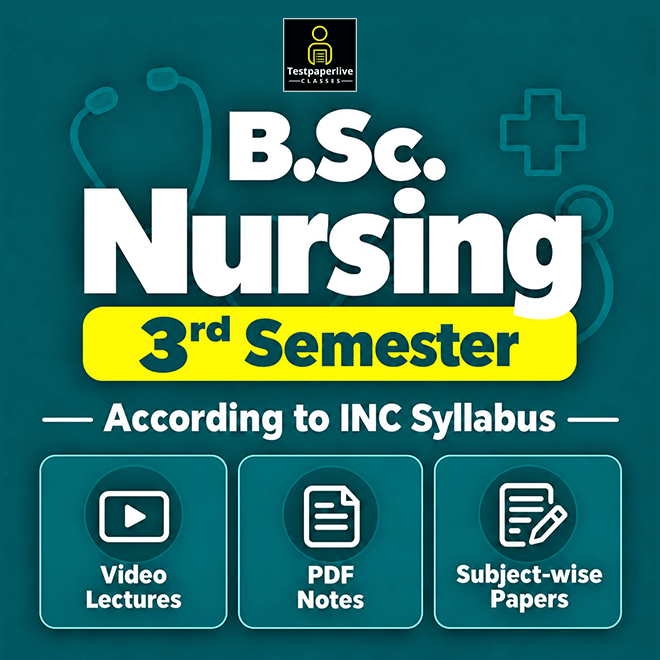
| Third-semester classes | BSc Nursing 3rd Semester online classes |
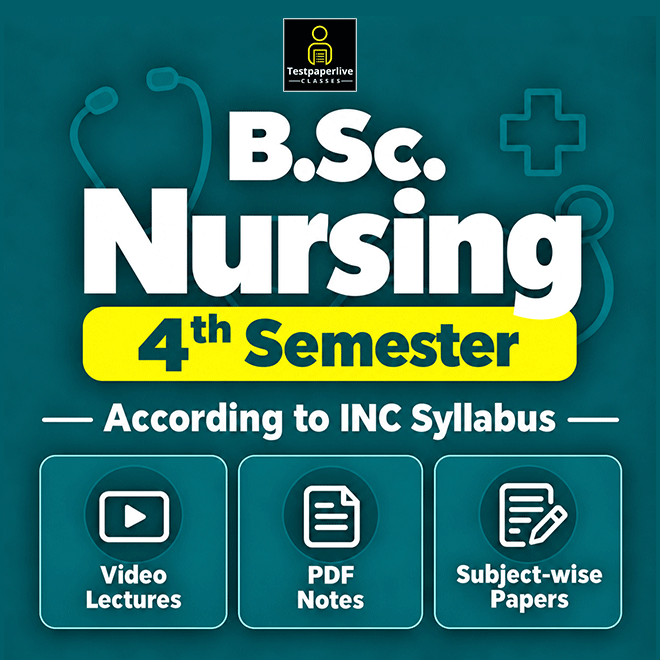
| Fourth-semester classes | BSc Nursing 4th Semester online classes |
| Free PDF notes | Check available free study material in the Testpaperlive Classes app and select the relevant subject. |
| Previous-year question papers | Look for available PYQs; confirm the university, paper title, semester, exam year and syllabus version. |
Check current course coverage, validity and access conditions before enrolling. Free resources and complete paid courses have different access terms, and PYQ availability varies by university and year. Semester courses are listed on the Testpaperlive website.
LEARN • REVISE • PRACTISE
Give your second-year preparation a clear direction
Explore online classes, free study material and available PYQ resources with Testpaperlive Classes.
Download Android App → Get the iPhone appA Practical Study Plan for Semester 3 and 4
Use the following as an editorial study routine, adjusting it around your lectures and clinical postings.
- Build a unit checklist: mark each unit as studied, revised and practised. Keep unfinished topics visible.
- Connect the subjects: revise a disease process, its related drug groups and the nursing-care principles in the same study session.
- Make short comparison tables: compare related concepts using a few meaningful headings. Check them against class notes before using them for revision.
- Write one answer daily: practise a short answer or an organised long-answer outline. Include relevant diagrams where they improve the explanation.
- Review practical feedback weekly: update your record and prepare the questions you need to ask your instructor.
- Attempt matching PYQs: work to time, review missing points and return to the syllabus for topics that were not tested.
Before examinations: keep separate revision sheets for definitions, drug groups, disease mechanisms and nursing-care plans. Use practice papers to improve the structure and timing of your answers, while completing the full prescribed syllabus. Repeated questions help identify useful practice areas but do not guarantee what will appear in the next paper.