RRB RADIOGRAPHER · 2026 PREPARATION GUIDE
Your exam at a glance
Quick answer: Prepare radiography subjects alongside general awareness, arithmetic and reasoning, and Class 10 science. The reference CBT format is 100 questions, 100 marks and 90 minutes, with 70 professional questions and one-third negative marking. Use the topic checklist below to organise your revision.
100
Questions
Total in CBT
90 min
Duration
Standard time
70 + 30
Marks split
Professional + general
−⅓
Negative marking
Per wrong answer
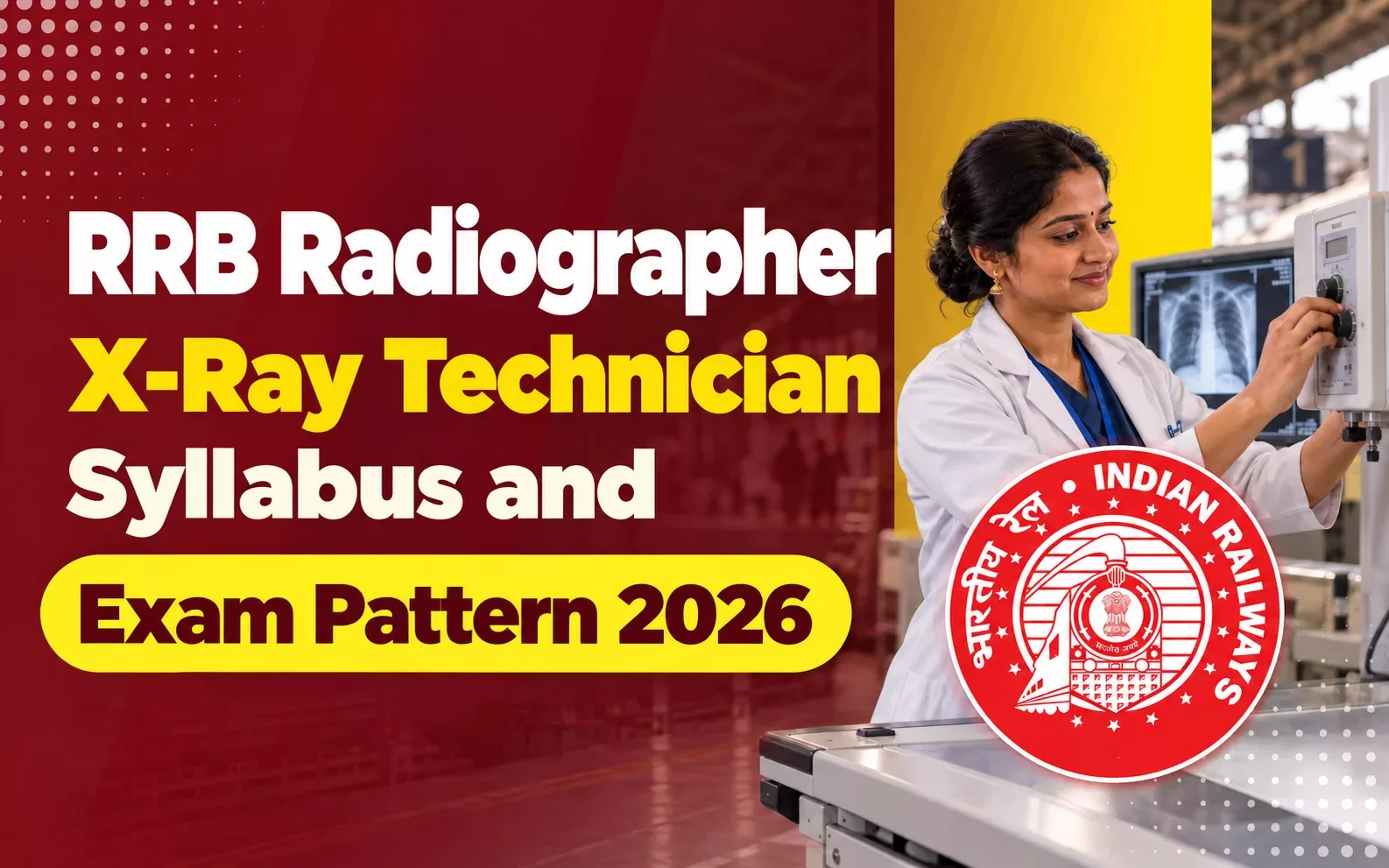
The RRB Radiographer and X-Ray Technician syllabus and exam pattern 2026 guide helps you turn a broad subject list into a practical preparation plan. Start with the paper structure, revise the professional subjects systematically, and test your accuracy with timed practice.
SOURCE STATUS · 28 SEPTEMBER 2026
The professional syllabus below uses the accessible official CEN 03/2025, Annexure C as its reference. The linked CEN 05/2026 PDF could not be independently read during this review. Treat this as a preparation reference; confirm the current recruitment’s syllabus and rules from CEN 05/2026 before relying on them for that cycle. Detailed study examples and the revision plan are editorial guidance.
Jump to: Exam pattern · Professional syllabus · General subjects · Marking · Study plan · Sources
RRB Radiographer Exam Pattern 2026: Reference CBT Structure
Use the following structure for practice papers. Current CEN 05/2026 summaries also report this format, but the new official PDF still needs verification. The section split is indicative, so do not assume an identical distribution in every paper.
| Section | Questions | Marks |
|---|---|---|
| Professional Ability — Radiography | 70 | 70 |
| General Awareness | 10 | 10 |
| General Arithmetic, Intelligence & Reasoning | 10 combined | 10 combined |
| General Science | 10 | 10 |
| Total | 100 | 100 |
The standard time is 90 minutes; the reported provision for PwBD candidates eligible for a scribe is 120 minutes, subject to the applicable notification. Questions are objective multiple-choice. The reported selection route is CBT, document verification and medical examination. Current CEN 05/2026 pattern summary.
RRB Radiographer & X-Ray Technician Professional Syllabus
The reference syllabus covers anatomy and physiology; general, radiological and diagnostic radiation physics; X-ray equipment and maintenance; film/image processing; positioning; ethics, patient care and emergencies; modern modalities; contrast studies; and quality control with radiation safety. See Annexure C of the official reference notification.
How to use this checklist: The rows below expand those broad subjects into suggested revision tasks. They are not a new official subtopic list, a chapter-wise marks allocation or a prediction of questions.
| Study area | Suggested revision checklist |
|---|---|
| Anatomy & physiology | Sketch the major organ systems and label bones, joints and anatomical planes. Connect each region to the positioning diagrams in your diploma or degree notes. |
| Physics foundations | Make one-page notes on atoms, electricity, electromagnetic waves, X-ray production and interactions with matter. Practise explaining each concept without looking at the answer. |
| Diagnostic imaging physics | Build a comparison sheet for kVp, mAs, distance, filtration, collimation and grids. Work through exposure-factor numericals from your standard course material. |
| Equipment & maintenance | Label an X-ray tube and generator diagram. Compare fixed, mobile and fluoroscopic equipment; review routine equipment checks from your training notes. |
| Film & image processing | Draw a processing workflow and create an artefact-to-cause chart. Compare film-screen imaging, computed radiography and digital radiography at a conceptual level. |
| Clinical positioning | Prepare a projection notebook for limbs, chest, abdomen, pelvis, spine and skull. Record patient position, beam direction, centring and image-evaluation points together. |
| Contrast & special studies | Create comparison tables for gastrointestinal, urinary and other special investigations. Revise terminology, purpose, preparation principles and safety from approved teaching material. |
| Modern imaging modalities | Compare CT, MRI, ultrasound, mammography and other modalities covered in your course. Summarise image formation, common terminology, equipment and safety differences. |
| Patient care, ethics & emergencies | Revise identification, consent, communication, infection prevention and emergency recognition through classroom scenarios. Keep this revision within your professional training and scope. |
| Quality control & radiation safety | Make a checklist of image-quality checks, protection principles, monitoring devices and quality-assurance terminology. Verify changing regulatory limits against current official material. |
Keep a three-column tracker for every topic: concept revised → MCQs practised → mistakes corrected. Completing a chapter without reviewing incorrect answers leaves the same weak points unresolved.
General Subjects: The Remaining 30 Marks
The official reference annexure includes numerical skills, reasoning, current affairs and general knowledge, plus Physics, Chemistry and Life Sciences at Class 10 CBSE level. Read the common syllabus in Annexure C.
Arithmetic and reasoning practice
Build short mixed sets around percentages, ratios, work and speed problems, basic geometry, data interpretation, series, coding and logical relationships. Maintain a separate formula page and a record of calculation errors. Rotate topic types instead of repeating only the exercises you already solve comfortably.
General awareness practice
Use concise daily notes for current events and scheduled revision for history, geography, polity, economy, environment, sports and scientific developments. Check names and dates against reliable sources. Convert notes into questions so that revision tests recall rather than familiarity.
General science practice
Revise school-level concepts before attempting mixed MCQs. Explain the reasoning behind each answer in a sentence. If a wrong answer reveals a conceptual gap, revisit the relevant textbook section before taking another test.
Negative Marking and Minimum Qualifying Marks
For the reported +1 / −⅓ scheme, estimate a raw practice score as correct answers − (wrong answers ÷ 3). For example, 75 correct, 15 incorrect and 10 unanswered questions produce 70 marks. This practice calculation does not reproduce any official normalisation.
| Category | Reported minimum qualifying percentage |
|---|---|
| UR / EWS | 40% |
| OBC (NCL) / SC | 30% |
| ST | 25% |
These are qualifying thresholds, not guaranteed selection cut-offs. The reported PwBD shortage provision permits a relaxation of two marks where applicable. Check the precise current clause before using it. CEN 05/2026 recruitment summary.
Mock-test habit: Track accuracy separately from attempts. Mark questions you answered through elimination, then review whether the reasoning was sound. Do not treat a guessed correct answer as a mastered concept.
A Practical 30-Day Revision Plan
This sample plan assumes you have already studied the subjects. Beginners can extend each block. Adjust the workload to your available time and the weaknesses identified in your first mock.
| Days | Main work | Checkpoint |
|---|---|---|
| 1–7 | Anatomy, physics and equipment; a short general-subject set each day | Create formula and diagram sheets; review one diagnostic mock |
| 8–14 | Positioning, processing and image-quality concepts | Complete a projection notebook and classify recurring mistakes |
| 15–21 | Contrast studies, modern modalities, patient care and safety | Practise mixed professional sets; revisit weak concepts |
| 22–27 | Full syllabus revision with timed practice | Alternate mock tests with detailed review sessions |
| 28–30 | Error notebook, key diagrams and concise notes | Use a light final revision schedule; check official exam instructions |
A possible three-hour session is 100 minutes of professional revision, 40 minutes of general subjects and 40 minutes of MCQs with review. This is a suggested allocation, not an RRB instruction. Keep enough review time to understand why each incorrect option was unsuitable.
How to Use Previous Papers and Mock Tests
- Take a baseline test. Record your score, completion time and section-wise errors.
- Diagnose the mistake. Separate missing knowledge, incorrect calculations, misread questions and time pressure.
- Repair the concept. Return to your course notes and write a brief correction in your own words.
- Retest later. Use a fresh question on the same concept so that you test understanding rather than memory of an answer key.
Start with the RRB Radiographer previous-paper guide. Older papers help with practice; their chapter distribution does not guarantee the pattern of a future paper.
Turn your syllabus into a revision routine
Explore Testpaperlive’s radiographer preparation resources and choose practice that matches the topics you need to improve.
Explore RRB Radiographer Test SeriesSyllabus PDF, Sources and Recruitment-Cycle Check
- Official CEN 03/2025 reference PDF — Annexure C contains the professional and common syllabus used for this preparation checklist.
- CEN 05/2026 PDF link — access was rejected during this review; current-cycle verification remains pending.
- Official RRB portal — check the applicable notice and corrigenda.
Before using a notification: Confirm its CEN number, the post name and the syllabus annexure. A recruitment notice’s year and the year of its CBT may differ. Do not transfer exam dates from CEN 03/2025 to CEN 05/2026.
Related reading: RRB Radiographer recruitment guide · DRT first-year syllabus · DRT second-year syllabus.