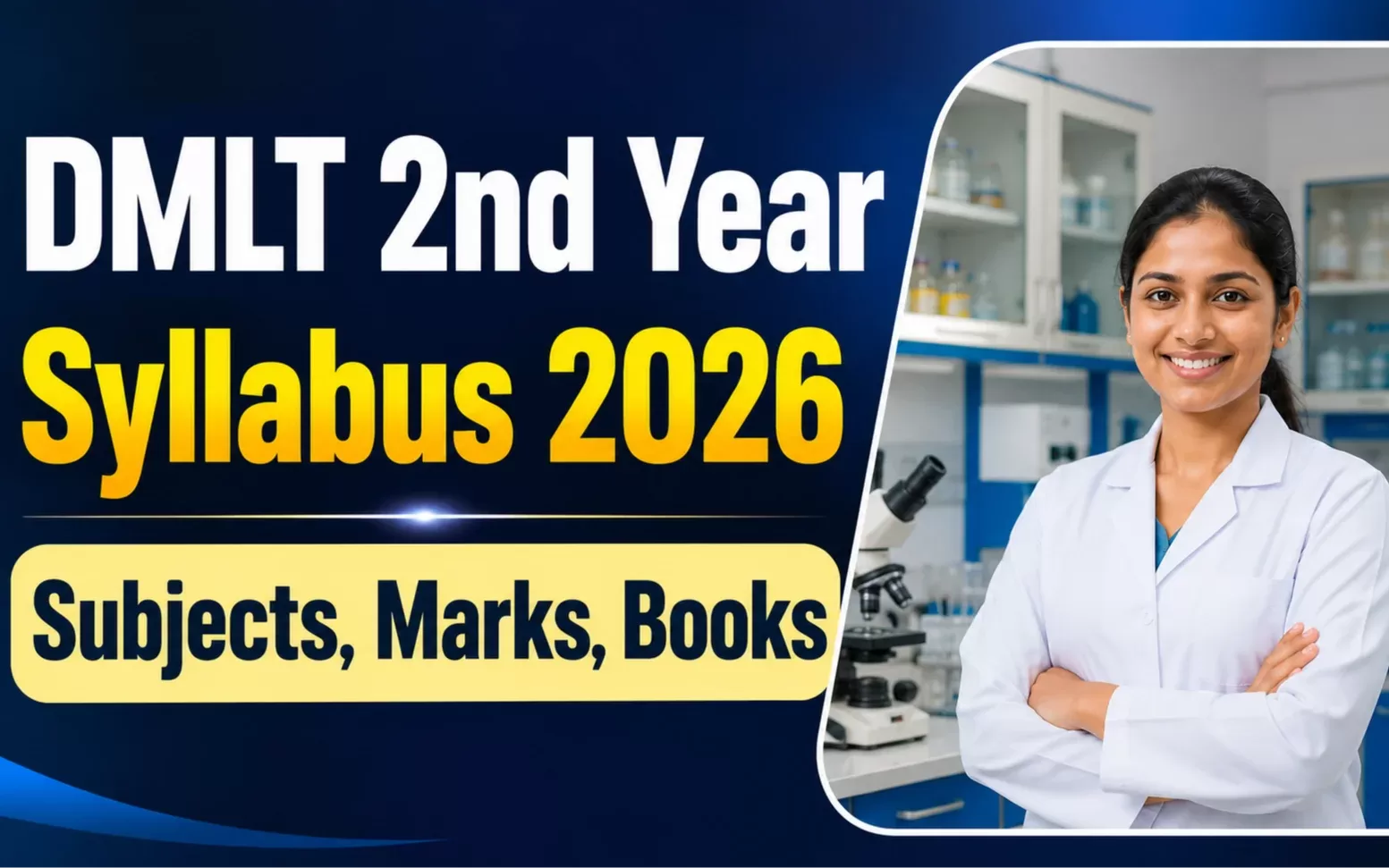
After completing the first year, students move on to the more advanced and specialised DMLT 2nd Year Syllabus. DMLT is one of the most popular Allied Health Sciences courses in India, and the second year of DMLT (Diploma in Medical Laboratory Technology) focuses on core diagnostic subjects like Pathology, Microbiology and Biochemistry, which are essential for a professional lab technician. In this article we have shared the complete DMLT 2nd Year Syllabus 2026 including subjects, marks distribution, practical papers, recommended books and a free PDF download link.
DMLT 2nd Year Course Overview
| Particulars | Details |
|---|---|
| Course Name | Diploma in Medical Laboratory Technology (DMLT) |
| Year | Second Year (Final Year) |
| Course Duration | 2 Years (1st Year + 2nd Year) |
| Core Subjects | Microbiology, Pathology, Biochemistry |
| Examination Type | Yearly / Semester (Theory + Practical + Viva) |
| 2nd Year Total Marks | 1350 (Theory + Practical + Viva-voce) |
| Includes | Hospital / Industrial Training (Internship) |
DMLT 2nd Year Subjects List
The DMLT second year covers advanced laboratory subjects along with professional and environmental papers. Below is the list of subjects taught in the 2nd year:
- Entrepreneurship & Professional Management
- Environmental Studies
- Microbiology (including Parasitology & Immunology)
- Pathology
- Biochemistry
- Clinical Practical Training - II
- MLT Instruments Practice Lab - II
- Hospital Industrial Training (4 Weeks Summer Vacation)
DMLT 2nd Year Marks Distribution (Paper Scheme)
| Paper | Subject | Theory | Practical | Viva | Total |
|---|---|---|---|---|---|
| Paper I | Entrepreneurship & Professional Management | 100 | - | - | 100 |
| Paper II | Environmental Studies | 100 | - | - | 100 |
| Paper III | Microbiology (Parasitology & Immunology) | 100 | - | - | 100 |
| Paper IV | Pathology | 100 | - | - | 100 |
| Paper V | Biochemistry | 100 | - | - | 100 |
| Practical | Clinical Practical Training - II | - | 400 | 200 | 600 |
| Practical | MLT Instruments Practice Lab - II | - | 100 | 50 | 150 |
| Practical | Hospital Industrial Training | - | 100 | - | 100 |
| Total | Grand Total | 1350 |
DMLT 2nd Year Syllabus (Subject-Wise Topics)
1. Entrepreneurship & Professional Management
This subject prepares students to start and manage their own diagnostic lab or business.
- Concept, need, scope and characteristics of entrepreneurship
- Women entrepreneurship and support organizations (SIDO, NSIC, KVIC)
- Innovation, creativity and intellectual property rights (IPR)
- Project formulation and preparation of project reports
- Financial sources for small scale industries (SSI loans)
- Rules, regulations, licensing, factory act and taxation basics
2. Environmental Studies
A compulsory subject for all paramedical students focusing on pollution and biomedical waste.
- Biotic and abiotic environment, adverse effects of pollution
- Water pollution and water quality standards
- Air, noise and soil pollution
- Environmental acts and regulations
- Biomedical waste management
3. Microbiology (including Parasitology & Immunology)
One of the most important 2nd year subjects, covering infectious agents and immune response.
- Human parasitology - protozoa, nematodes and platyhelminthes
- Systemic bacteriology - gram positive & negative cocci and bacilli
- Culture, morphology and biochemical identification of bacteria
- Mycobacteria and spirochaetes (T. pallidum)
- Virology - HIV and Hepatitis viruses
- Immunology - antigen-antibody reactions, ELISA, PCR, hypersensitivity
4. Pathology
Deals with the study of disease processes and laboratory diagnostic techniques.
- Histopathology - tissue processing, block making and section cutting
- Haematoxylin & Eosin (H&E) staining and special staining techniques
- Immuno-histochemical and cytological staining
- Coagulation studies - BT, CT, PT, APTT, thrombin time and FDP
- Investigation of bleeding disorders
- Museum techniques and specimen preservation
5. Biochemistry
Focuses on the chemical analysis of body fluids used in disease diagnosis.
- Kidney function tests (KFT) and urine constituents
- Liver function tests (LFT) and types of jaundice
- Cardiac profile tests and their significance
- Pancreatic enzymes and diagnostic importance
- Chemistry of blood, hemoglobin and porphyrias
- Special investigations - RIA, ELISA and chemiluminescence
- Quality control and automation in clinical biochemistry
6. Practical Training
The 2nd year includes intensive practical training, MLT instruments practice and a hospital / industrial internship, which carry the highest marks weightage.
DMLT 2nd Year Recommended Books
- Medical Laboratory Manual for Tropical Countries – Monica Cheesbrough
- Textbook of Medical Laboratory Technology – Ramnik Sood
- Practical Microbiology – Prof. C.P. Baveja
- Practical Clinical Biochemistry – Harold Varley
- Medical Laboratory Technology (Vol I, II & III) – Kanai L. Mukherjee
DMLT 2nd Year Syllabus PDF Download
You can download the official DMLT 2nd Year Syllabus PDF to view the complete detailed syllabus, marks scheme and practical papers. Keep it handy for quick revision before your exams.
👉 Also Read: DMLT 1st Year Syllabus 2026: Subjects, Marks, Books & PDF Download
Conclusion
The DMLT 2nd Year Syllabus builds on the basics learned in the first year and focuses on advanced diagnostic subjects like Pathology, Microbiology and Biochemistry. As DMLT is an important branch of Allied Health Sciences, mastering these subjects along with regular practical training will help you become a skilled and job-ready medical lab technician. Plan your studies subject-wise and give extra attention to the practical papers, as they carry the highest marks.