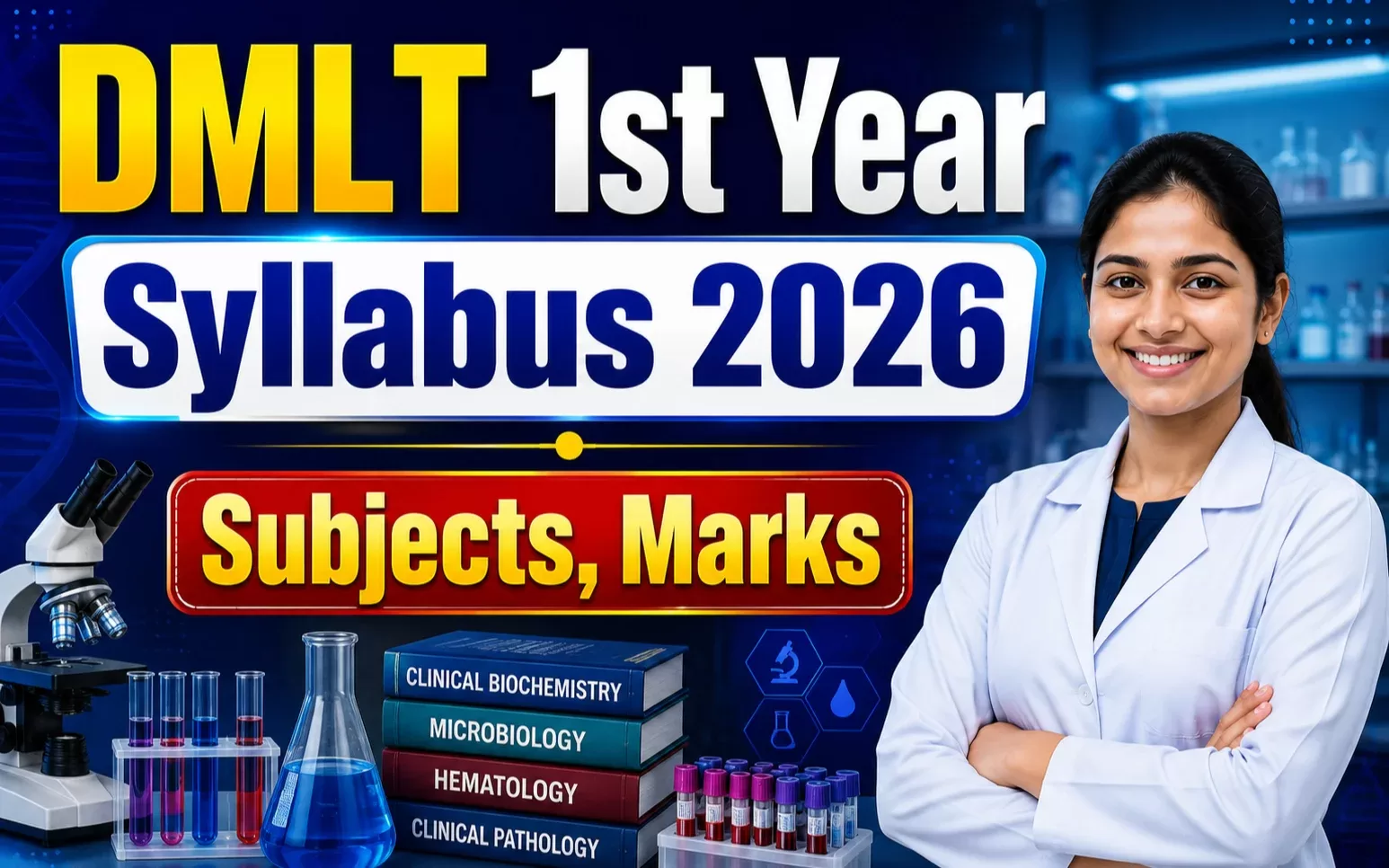
Are you planning to pursue a career in the medical laboratory field? The DMLT 1st Year Syllabus is the first step toward becoming a qualified lab technician. DMLT (Diploma in Medical Laboratory Technology) is a 2-year paramedical course and one of the most popular Allied Health Sciences courses in India, that trains students to perform clinical laboratory tests used in the diagnosis and treatment of diseases. In this article we cover the complete DMLT 1st Year Syllabus 2026 including subjects, marks distribution, practical papers, recommended books and a free PDF download link.
DMLT Course Overview
| Particulars | Details |
|---|---|
| Course Name | Diploma in Medical Laboratory Technology (DMLT) |
| Course Level | Diploma (Paramedical) |
| Course Duration | 2 Years (Divided into 1st & 2nd Year) |
| Eligibility | 10+2 with Science (Physics, Chemistry, Biology) |
| Examination Type | Yearly / Semester (Theory + Practical + Viva) |
| 1st Year Total Marks | 1350 (Theory + Practical + Viva-voce) |
| Job Roles | Lab Technician, Lab Assistant, Phlebotomist |
DMLT 1st Year Subjects List
The DMLT first year focuses on building a strong foundation in basic medical sciences and core laboratory subjects. Below is the list of subjects taught in the 1st year:
- Communication Skills in English
- Computer Application
- Anatomy and Physiology
- Hematology and Blood Banking
- Clinical Pathology
- Clinical Practical Training
- MLT Instruments Practice Lab - 1
- Hospital Industrial Training (4 Weeks Summer Vacation)
DMLT 1st Year Marks Distribution (Paper Scheme)
| Paper | Subject | Theory | Practical | Viva | Total |
|---|---|---|---|---|---|
| Paper I | Communication Skills in English | 100 | - | - | 100 |
| Paper II | Computer Application | 100 | - | - | 100 |
| Paper III | Anatomy and Physiology | 100 | - | - | 100 |
| Paper IV | Hematology and Blood Banking | 100 | - | - | 100 |
| Paper V | Clinical Pathology | 100 | - | - | 100 |
| Practical | Clinical Practical Training | - | 400 | 200 | 600 |
| Practical | MLT Instruments Practice Lab - 1 | - | 100 | 50 | 150 |
| Practical | Hospital Industrial Training | - | 100 | - | 100 |
| Total | Grand Total | 1350 |
DMLT 1st Year Syllabus (Subject-Wise Topics)
1. Communication Skills in English
This subject improves the language and communication ability of students so they can handle reports and interact professionally in a lab setting.
- Grammar, tenses, sentence structure and vocabulary
- Prepositions, phrases and idioms
- Comprehension and précis writing
- Letter writing, paragraph writing and report writing
2. Computer Application
An introduction to computer technology and its use in the medical laboratory.
- Computer organization, CPU and memory (RAM, ROM, storage devices)
- Input and output devices
- Operating systems and MS Windows
- Word processing, presentation packages and MS Office
- Basics of internet and data handling
3. Anatomy and Physiology
The study of the structure and normal functioning of the human body, essential for understanding diseases.
- Cells: structure and function
- Tissues: epithelial, muscular and connective tissue
- Blood and the circulatory system
- Digestive, respiratory and nervous systems
- Endocrine, urinary and reproductive systems
- Skeletal and muscular systems; ear, nose, tongue and skin
4. Hematology and Blood Banking
One of the most important core subjects covering the study of blood and transfusion science.
- Introduction to clinical hematology and laboratory glassware
- Blood sample collection, anticoagulants and vacutainers
- RBC, WBC, platelet and reticulocyte counting
- Hemoglobin estimation, PCV and blood indices
- ESR, peripheral blood smear and DLC
- Blood grouping (ABO & Rh), donor screening and blood storage
- Cross matching and transfusion reactions
5. Clinical Pathology
Covers the examination of body fluids and quality control in the laboratory.
- Introduction to clinical pathology and lab safety measures
- Quality control (internal and external)
- Urine analysis: physical, chemical and microscopic examination
- Cerebrospinal fluid (CSF) and other body fluid examination
- Semen analysis
- Norms of biomedical waste management
6. Practical Training
Hands-on practical work forms a major part of the 1st year, including clinical practical training, MLT instruments practice and a 4-week hospital industrial training during summer vacation.
DMLT 1st Year Recommended Books
- Medical Laboratory Manual for Tropical Countries – Monica Cheesbrough
- Practical Clinical Biochemistry – Harold Varley
- Textbook of Medical Laboratory Technology – Ramnik Sood
- Practical Microbiology – Prof. C.P. Baveja
- Foundation of Computing – P.K. Sinha
DMLT 1st Year Syllabus PDF Download
You can download the official DMLT 1st Year Syllabus PDF to view the complete detailed syllabus, marks scheme and practical papers. Save it for easy revision and exam preparation.
👉 Also Read: DMLT 2nd Year Syllabus 2026: Subjects, Marks, Books & PDF Download
Conclusion
The DMLT 1st Year Syllabus lays the foundation for a successful career in medical laboratory technology and Allied Health Sciences by covering essential subjects like Anatomy, Physiology, Hematology, Blood Banking and Clinical Pathology. Understanding the subject-wise topics and marks distribution will help you plan your studies and score well in exams. Keep practicing the practical components regularly, as they carry the highest weightage in the 1st year.