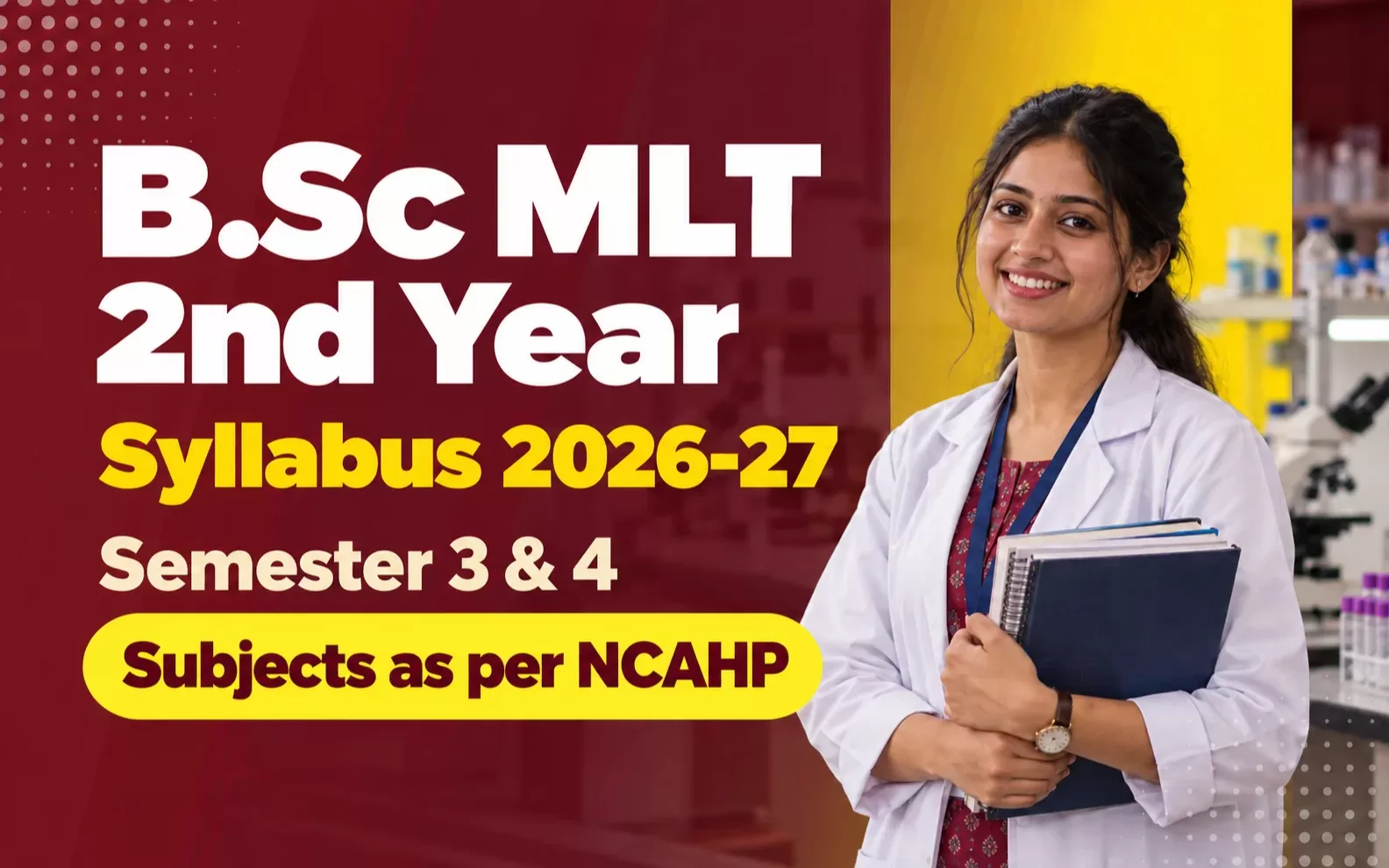
B.Sc. MLT 2nd Year (NCAHP name: Bachelor of Medical Laboratory Science – B.MLS) covers Semester 3 and 4. Semester 3: Bacteriology, Intermediary Metabolism & Endocrinology, Clinical Haematology, Basics of Pharmacology. Semester 4: Virology & Immunology, Genetics & Molecular Biology, Clinical Pathology, Medical Laboratory Management & Quality Control — each main subject with a practical. Each semester has 20 credits and 700 marks.
Whether your university calls it BMLT, B.Sc. MLT, B.Sc. Medical Lab Technology or BMLS, the national standard is the NCAHP Competency Based Curriculum for Medical Laboratory Sciences (released 15 October 2025, implementation from 2026–27). This post gives the complete 2nd year (Semester 3 & 4) syllabus with credits, marks and unit-wise topics.
B.Sc. MLT 2nd Year at a Glance
| Particulars | Details |
|---|---|
| Course | Bachelor of Medical Laboratory Science (B.MLS) – popularly B.Sc. MLT / BMLT |
| 2nd Year Semesters | Semester 3 and Semester 4 |
| Credits | 20 per semester (40 in 2nd year) |
| Marks | 700 per semester (each paper 30 internal + 70 end-semester) |
| Attendance | 80% theory and 80% practical |
| Promotion to 3rd Year | Cumulative minimum 80% of credits of Semester 1 to 4 |
| Regulator | National Commission for Allied and Healthcare Professions (NCAHP) |
B.Sc. MLT 2nd Year – Semester 3 Syllabus
| Subject | Credits | Marks (Int + Ext) |
|---|---|---|
| Bacteriology | 4 | 30 + 70 = 100 |
| Intermediary Metabolism and Endocrinology | 4 | 30 + 70 = 100 |
| Clinical Haematology | 4 | 30 + 70 = 100 |
| Basics of Pharmacology | 2 | 30 + 70 = 100 |
| Bacteriology Practical | 2 | 30 + 70 = 100 |
| Intermediary Metabolism and Endocrinology Practical | 2 | 30 + 70 = 100 |
| Clinical Haematology Practical | 2 | 30 + 70 = 100 |
| Total | 20 | 700 |
Semester 3 – Unit-wise Topics
| Subject | Main Topics |
|---|---|
| Bacteriology | Gram-positive cocci, Gram-negative cocci, spore-forming bacteria, mycobacteria, anaerobes, Enterobacteriaceae, Vibrio, Pseudomonas & Burkholderia, Mycoplasma, Actinomycetes & Nocardia, types of infections & diagnosis, nosocomial (hospital) infections |
| Intermediary Metabolism and Endocrinology | Metabolism of carbohydrates, lipids and proteins, integration of metabolism, purine & pyrimidine metabolism, hormones |
| Clinical Haematology | Anaemias, leukaemia, haemostasis disorders, cytogenetics (karyotyping, FISH), basics of flow cytometry with CD markers |
| Basics of Pharmacology | General pharmacology, antimicrobial chemotherapy, drugs for hormonal & metabolic disorders, drugs acting on blood and blood-forming organs |
B.Sc. MLT 2nd Year – Semester 4 Syllabus
| Subject | Credits | Marks (Int + Ext) |
|---|---|---|
| Virology and Immunology | 4 | 30 + 70 = 100 |
| Genetics and Molecular Biology | 4 | 30 + 70 = 100 |
| Clinical Pathology | 4 | 30 + 70 = 100 |
| Medical Laboratory Management and Quality Control | 2 | 30 + 70 = 100 |
| Virology and Immunology Practical | 2 | 30 + 70 = 100 |
| Genetics and Molecular Biology Practical | 2 | 30 + 70 = 100 |
| Clinical Pathology Practical | 2 | 30 + 70 = 100 |
| Total | 20 | 700 |
Semester 4 – Unit-wise Topics
| Subject | Main Topics |
|---|---|
| Virology and Immunology | Introduction to virology, cultivation & detection of viruses, lab diagnosis of viral infections, medically important viruses, prevention & precautions in virology; immune system, antigen & antibody, complement system, autoimmune diseases, immunisation/vaccination |
| Genetics and Molecular Biology | Introduction to genetics, chromosomal basis of inheritance, cell division, molecular basis of inheritance (DNA structure), gene expression & regulation, molecular diagnostics |
| Clinical Pathology | Urine analysis, faecal (stool) analysis, semen analysis, sputum analysis, body fluids, recent advances in clinical pathology |
| Medical Laboratory Management and Quality Control | Total quality management of clinical laboratory, accreditation & certification (NABL), automation in laboratory workflow, laboratory information system, sustainability of clinical laboratories |
Old Annual Pattern – B.Sc. MLT 2nd Year Papers (Examples)
| University | 2nd Year Papers (Annual System) |
|---|---|
| AIIMS Bhubaneswar – B.Sc. (Hons.) MLT | Transfusion Medicine; Pathology-II (Special Haematology); Microbiology-II (Bacteriology & Parasitology); Biochemistry-II (Clinical Biochemistry) |
| ABVMU Lucknow (UP) – BMLT | Blood Bank Procedure & Haemoglobinopathies; Endocrinology, Tumour & Cancer Markers; Clinical Biochemistry; Immunology, Serology, Parasitology |
Course names in states: Rajasthan (RUHS) – B.Sc. (Medical Lab Technology); UP (ABVMU) – BMLT / BMLS; Bihar (AKU) – BMLT; AIIMS – B.Sc. (Hons.) MLT; NCAHP – B.MLS. Confirm the exact subjects with your university.
Exam & Promotion Rules (NCAHP)
| Rule | Details |
|---|---|
| Marks per Paper | 100 = 30 continuous assessment + 70 end-semester exam |
| Grading | A+ (10), A (9), B (8), C (7), D (6), E (5), F (0) |
| Attendance | 80% in theory and 80% in practical |
| 2nd → 3rd Year Promotion | Cumulative minimum 80% of credits at the end of 2nd year (Semester 1 to 4) |
How to Score Well in B.Sc. MLT 2nd Year
| Tip | What to Do |
|---|---|
| Bacteriology charts | Make a chart of organisms – Gram stain, culture media, key tests |
| Haematology slides | Practise peripheral smear and blood cell identification daily |
| Clinical pathology | Learn normal values of urine, stool, semen and body fluids |
| Quality control | Understand Levey-Jennings chart, Westgard rules and NABL basics – asked in govt exams too |
Conclusion
B.Sc. MLT 2nd year moves from basics to core lab subjects — bacteriology, clinical haematology, virology & immunology, molecular biology and clinical pathology — in Semester 3 and 4 as per the NCAHP B.MLS curriculum.
Other years: B.Sc. MLT 1st Year Syllabus · B.Sc. MLT 3rd Year Syllabus · More Lab Technician Guides
TESTPAPERLIVE CLASSES
Prepare Smarter for Lab Technician Exams
Daily live classes, topic-wise MCQs and full mock tests for AIIMS, ESIC, RRB and state paramedical exams.
▶ Join Live Classes on YouTube 💬 WhatsApp: 8078686728 📝 Lab Technician Test Series
Source: NCAHP Competency Based Curriculum for Medical Laboratory Sciences (B.MLS), released 15 October 2025 — ncahp.gov.in.